
Minnesota VINELink Release Coverage
Minnesota's official service is Minnesota VINE. It provides free, anonymous information checks and optional notifications tied to county-jail custody events. Its most important statewide boundary is simple: Minnesota VINE connects to county jails, not MNDOC prisons. A person sentenced to state prison must be checked through MNDOC sources, while federal custody requires the Bureau of Prisons.
VINE reflects event data supplied by participating justice agencies. It can show a current custody status, a facility, identifying information, and scheduled-release information when the feed provides it. A released or not-in-custody result describes the VINE event feed. It does not replace the sheriff's public record of the actual release date, time, and legal basis under Minnesota law.
The service is best used for one known person and a defined county custody event. It is not a permanent statewide archive of every person once held. A county can update its feed after booking, transfer, or release, and the visible state can change. Capture the facility, record identifier, and time checked so the later agency verification refers to the same event.
The live Minnesota VINE search is the starting point for a named county-jail inmate.

The state-specific search screen should be paired with the correct county and facility before a matching record is accepted.
- Custody status
- The current state supplied by the agency feed, such as in custody or released.
- Transfer
- A move from one custody holder to another, not necessarily release to the community.
- PIN
- The code used to acknowledge telephone notices and manage a registration.
- Maintaining agency
- The sheriff, jail, or corrections office that created and keeps the underlying record.
Search Minnesota VINELink by Person
Start with a full last name and first name. Partial names are allowed, and an offender or booking ID can narrow the search. Compare the facility and identifier rather than relying on a name alone. Similar names are common, and the wrong county can produce a convincing but incorrect match. Open the individual record only after those details align.
If no record appears, change the spelling and try a partial name. Then confirm whether the person was held in a Minnesota county jail. A missing entry can result from spelling, a purge, a transfer, feed delay, or coverage. It is not proof that no custody or release event occurred. The originating sheriff remains the source for local release and transfer data.
- Open the live Minnesota page in VINELink and select the person-search route.
- Enter the last and first name, or use an offender or booking ID if known.
- Review all matches and compare the county facility, identifying number, and other displayed details.
- Open the correct record and read the complete custody status rather than a search-list label alone.
- Note the facility and update information, then confirm a reported release with the sheriff that maintains the record.
The Minnesota VINE state page explains the service and links its official materials.
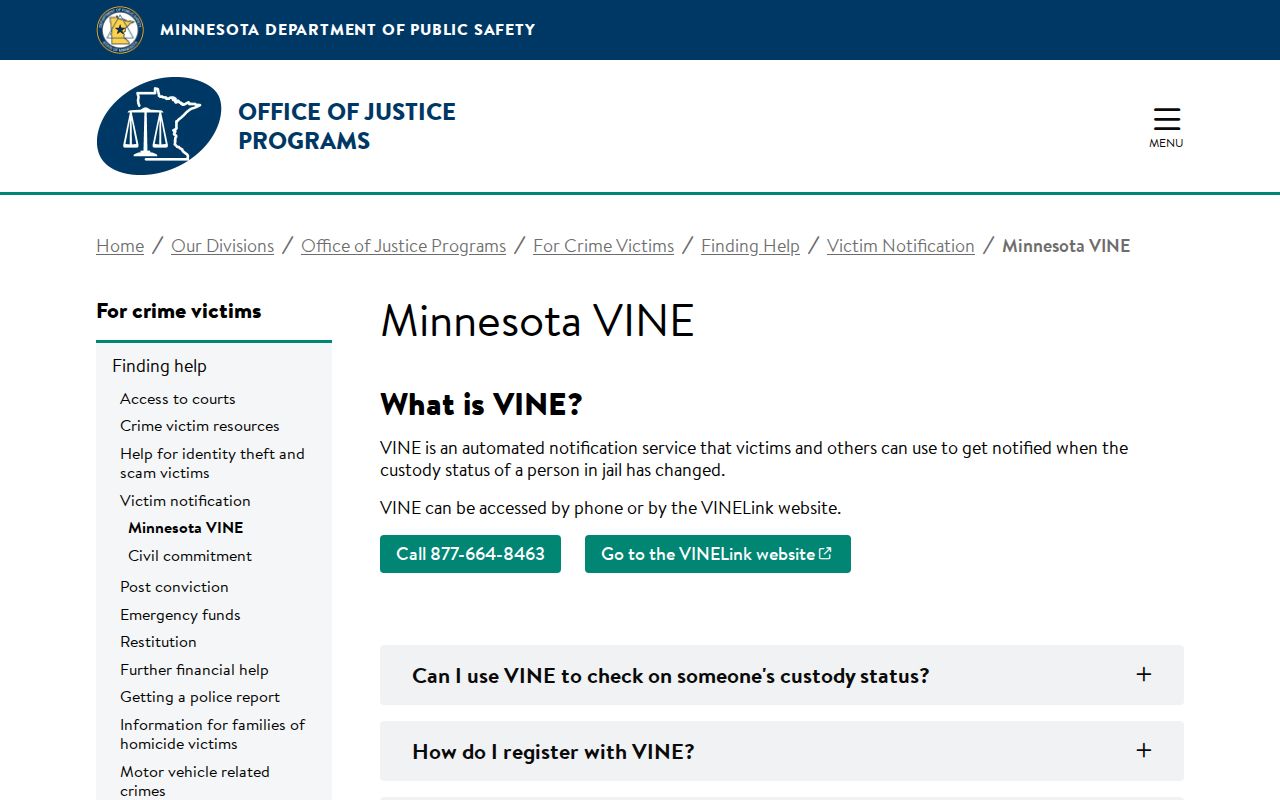
The state guidance is useful when the live interface changes or a registration needs support.
Note: Match the person with an ID and facility whenever possible, because a shared name alone is not enough for reliable release verification.
Minnesota VINE Release Fields
A Minnesota VINELink release record is an alert-system view, not the full sheriff release record. Read each displayed field in that context. Scheduled-release information may be present for a sentenced person, but the actual event can change. The sheriff's maintained section 13.82 data is the source for the date, time, and legal basis of a county release or transfer.
| Field | What it supports |
|---|---|
| Name | Identifies the record subject; compare other fields before selecting a match |
| Offender or booking ID | Separates people with similar names |
| Custody status | Reports the state in the current county feed |
| Facility | Names the county jail associated with the event |
| Scheduled release | Shows an expected date when the agency supplies one, not guaranteed departure |
| Event update | Helps assess when the feed last changed |
A roster serves a different purpose. A current jail roster primarily shows who is still held. A released person may drop off it. VINE may retain or transmit a release event, but the local release record remains the better source for the exact event. If a transfer occurred, the receiving agency becomes the next custody source.
The Minnesota data-request resources explain how to ask a government office for existing public data.
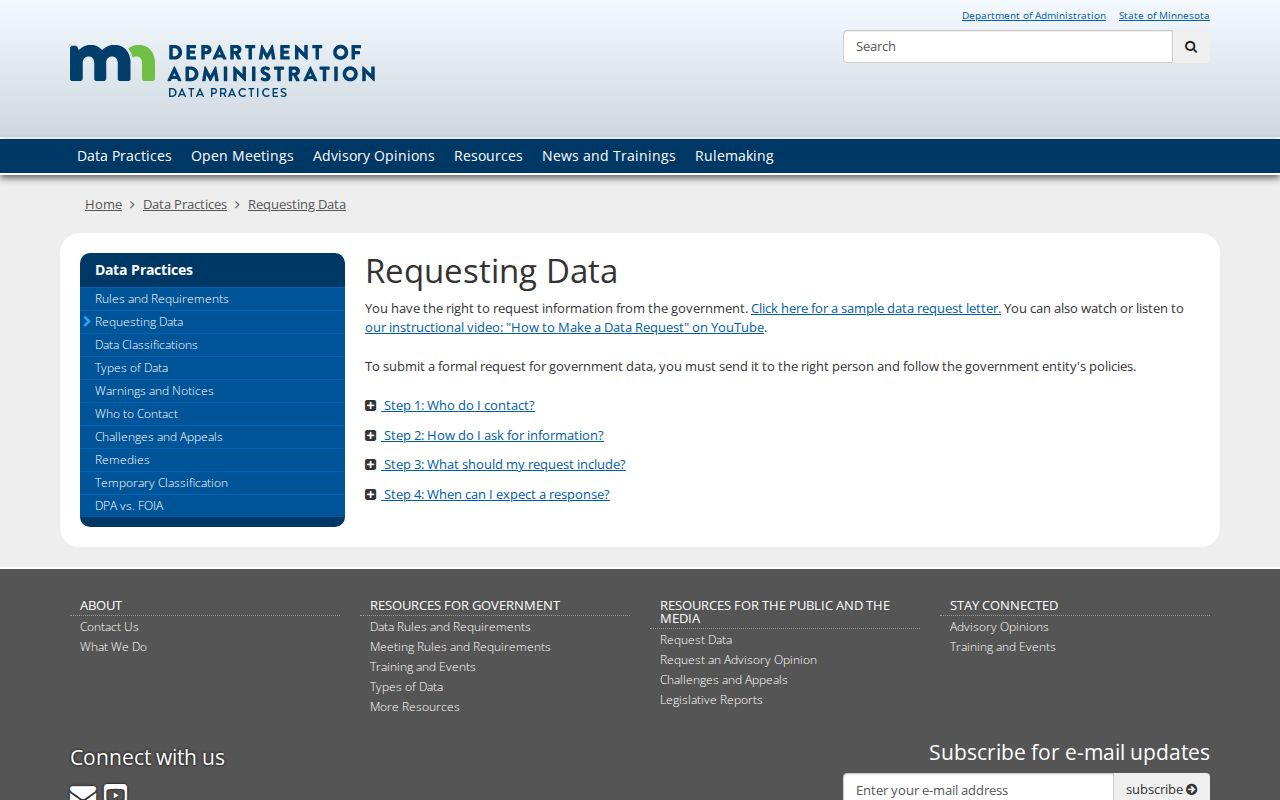
A focused request should name the person, facility, approximate event date, and the release or transfer fields sought.
Register Minnesota Release Notifications
Registration begins from the correct person record. Choose an offered phone, text, email, or app channel, enter the requested destination, and create a PIN. A personal name is not required, and an account is optional. Preserve the PIN. It acknowledges phone notices and is also used to change or cancel the registration.
Telephone alerts have their own delivery pattern. They repeat every 30 minutes for up to 24 hours until acknowledged with the PIN. After a non-confirming answer they recur every two hours, and a voicemail does not stop them. Ordinary calls occur from 7 a.m. through 9 p.m. Text, email, and app channels send one alert for each event.
Channel choice affects delivery, not the legal meaning of the event. A phone notice may repeat until the PIN is entered, while a text or email is sent once. If a message is missed, return to the correct person record and contact the maintaining jail. Do not assume that the absence of a second message means the status stayed the same.
- Open the matching county-jail record and choose the registration option.
- Select each offered notice channel that fits the need: phone, text, email, or app.
- Enter the destination accurately and create a PIN that can be kept private and found later.
- Confirm the registration and save the person, facility, and registration details.
- Acknowledge a phone notice with the PIN, then verify the reported event with the maintaining agency.
The Minnesota fact sheet lists telephone help at 877-664-8463, TTY at 866-847-1298, and technical or PIN help at 866-277-7477. Those contacts support VINE registration. They do not replace the county sheriff for a formal release record.
The official MNDOC result shows why the correct custody layer matters before registration.
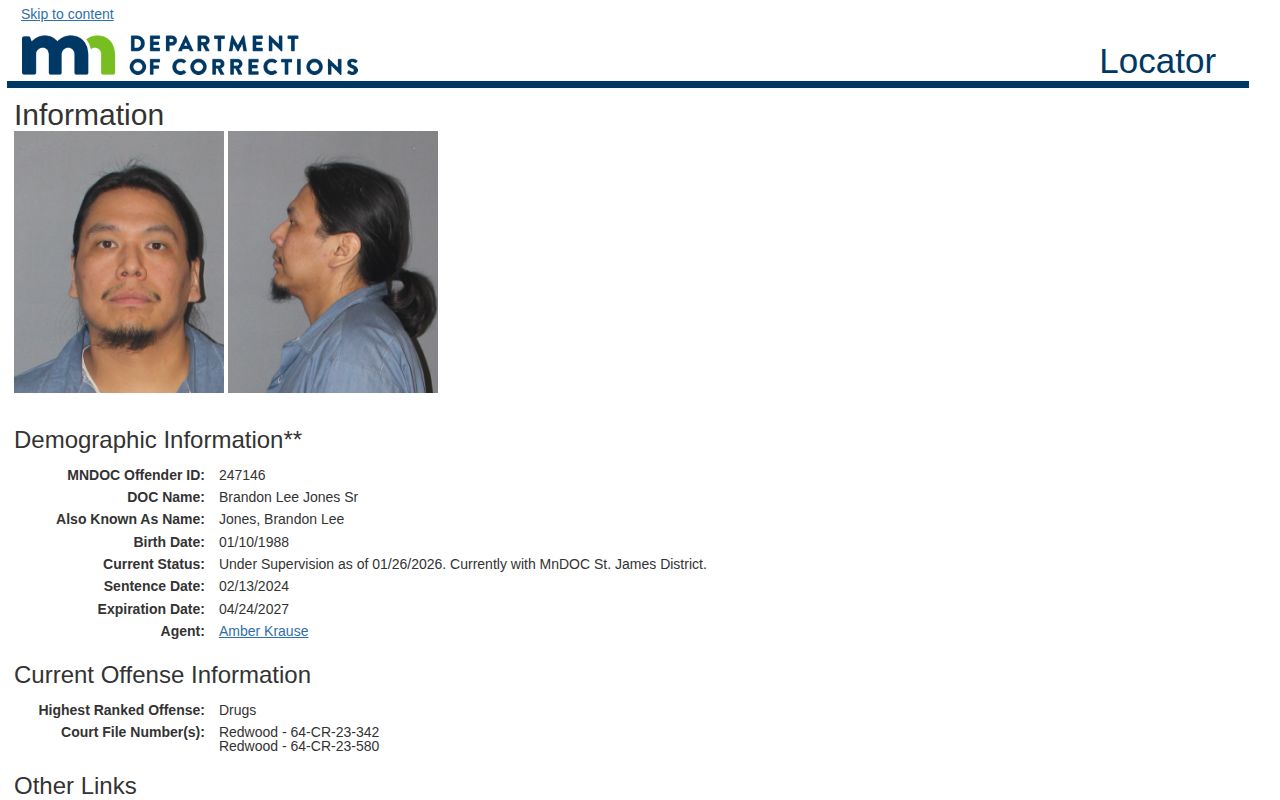
A state-prison supervision result belongs to MNDOC and Minnesota Haven, while a VINE alert must attach to the correct county-jail record.
Minnesota VINE and Haven Split
Minnesota divides notification by custody layer. County jails connect to Minnesota VINE, while MNDOC prison custody and release notification uses Minnesota Haven and Victim Assistance. A person who moves from county jail into state prison has not been released merely because the county system reports a transfer or stops showing current local custody.
County updates ordinarily reach VINE at 15- or 30-minute intervals. Alerts can still be delayed. The state fact sheet also says transfer notices have an eight-hour delay, while death notices have a twelve-hour delay. Those timing rules are a distinctive part of Minnesota's deployment and reinforce why an alert is not a certified timestamp.
Custody-layer limit: A county VINE transfer may mean movement into MNDOC custody, so verify the receiving agency before calling it release.
The Minnesota Department of Corrections home page identifies the state-prison agency outside the county VINE layer.
The agency boundary shown by MNDOC is why a state-prison event should not be sought from the county-only VINE feed.
Note: VINE timing is designed for notice, while the maintaining sheriff or MNDOC record supplies the official custody and release facts.
Confirm Minnesota VINELink Releases
VINELink does not track federal Bureau of Prisons inmates. For a federal sentence, the BOP Inmate Locator may show “RELEASED” and a Release Date. That means the person is no longer in BOP custody; it does not establish that all supervision or other jurisdiction has ended. Immigration detention is also separate and uses the ICE locator within its stated coverage.
The federal locator generally covers federal inmates from 1982 to the present, while older records may require another repository. ICE describes its locator as covering current detainees and people released from ICE custody within the prior 60 days. Those are separate federal systems. Neither result should be merged with a Minnesota county VINE event.
For county custody, contact the sheriff that supplied the VINE event and request the public release or transfer fields. Minnesota Statutes section 13.82 distinguishes release from transfer by providing public date, time, legal-basis, and receiving-agency fields. That distinction resolves the core question that an alert alone cannot always answer.
A state-prison case belongs in the MNDOC public viewer and, when notification eligibility applies, Minnesota Haven. A fully discharged person may fall outside the current MNDOC viewer, so historical or formal proof may require a focused Data Practices request. The Minnesota released inmates search path explains how these county, state, federal, and court records fit together.
Never treat a no-result as affirmative proof. Check spelling, ID, jail, transfer status, and feed timing. Then ask the maintaining agency for the exact existing record. That sequence keeps a Minnesota VINELink release check useful without asking it to serve as a permanent release archive.
When the sheriff confirms an event, compare the answer with the VINE notice. A release should have a date, time, and legal basis in the public arrest data. A transfer should identify its date, time, legal basis, and receiving agency. If the message says transfer but the person vanished from the jail roster, follow the receiving agency instead of labeling the event as freedom.
For formal proof, ask for inspection or copies of the existing release or transfer data under Minnesota Chapter 13. Inspection of public data is free, while lawful copy costs may apply. The request can name the full person, booking number if known, county jail, approximate date, and the precise fields sought. A denial must cite specific authority.
Keep alerts active only as needed and protect the PIN. VINE registration can be anonymous, but the phone number, email address, or app destination still controls delivery. Technical support can help with the registration. Only the maintaining jail can settle a dispute about the source event, and only the proper state or federal system can answer after custody moves outside the county layer today.