
MNDOC Offender Search Scope
MNDOC means the Minnesota Department of Corrections. It administers the state prison system and maintains public information about adults committed to the Commissioner of Corrections. Its viewer covers a sentenced state prisoner while incarcerated and can keep showing that person after prison when MNDOC supervision continues. That makes the system useful for verifying a prison-to-community transition. It does not turn the viewer into a full Minnesota arrest or county jail database.
The agency describes the public viewer through its Search Individuals and Fugitives hub. Separate routes exist for the ordinary public viewer, fugitives, and registrants. The viewer draws distinctions that matter: current prison custody, work release, supervision in the community, and the projected end of DOC jurisdiction are not one event. A person can also leave a county roster because of a transfer into MNDOC custody. That is continued confinement, not a release to the community.
The Minnesota Department of Corrections home page establishes the agency context shown below.
This agency-level source is the right starting point for state-prison records, while a sheriff remains the source for a local jail release.
Search MNDOC Release Records
Start with an MNDOC Offender ID when it is known. An agency ID is more precise than a name and helps separate people with similar names. Otherwise, the MNDOC Public Viewer accepts a first name, last name, or both. Search results must still be matched against birth date, aliases, current offense, and court-file information before drawing a conclusion. A name match alone is weak evidence.
- Open the official MNDOC public viewer and choose the individual search.
- Enter the MNDOC Offender ID, or search by first name, last name, or both.
- Compare identity details, including birth date, aliases, offense data, and the court file.
- Open the record and read the full Current Status sentence before using any date.
- Separate Anticipated Release Date from Expiration Date and from an “Under Supervision as of” status.
- Use Central Records when the person has fully discharged or a formal maintained record is needed.
The search form itself is visible on the official MNDOC Public Viewer.
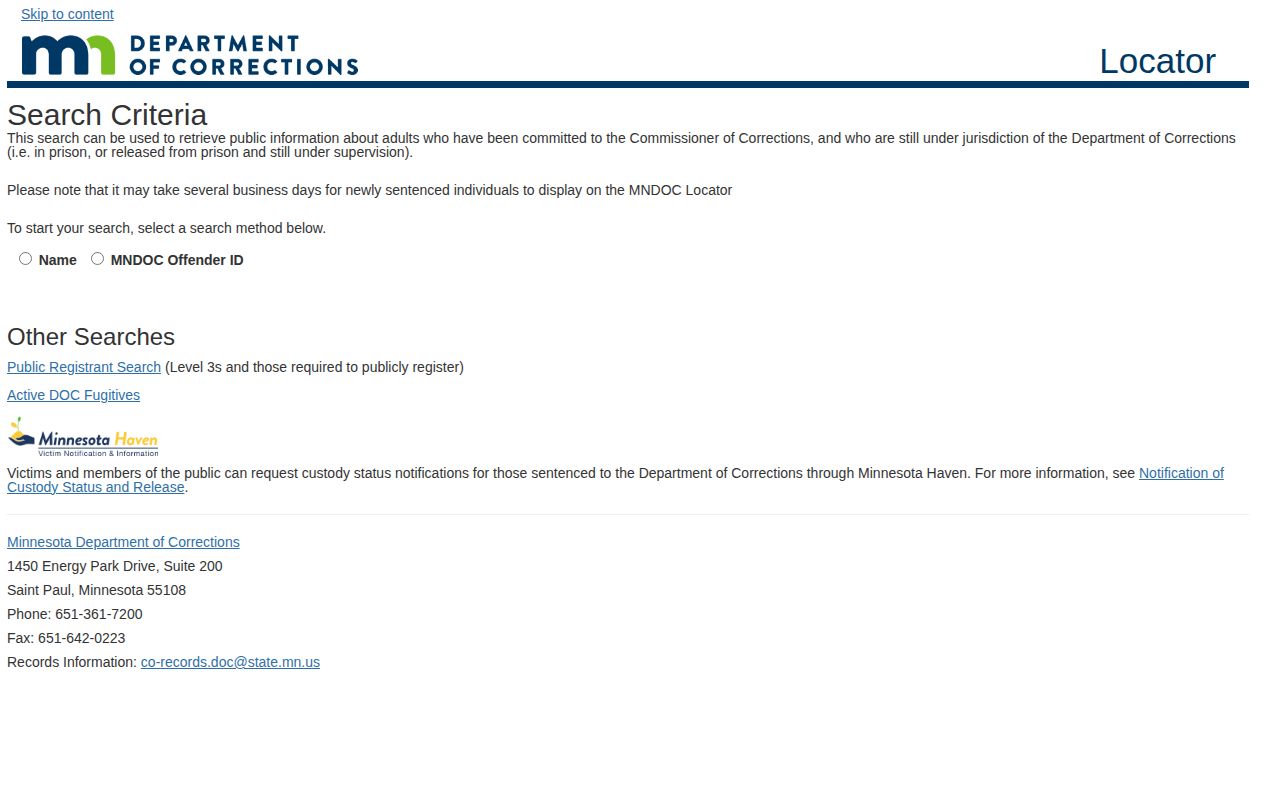
The form supports a focused search, but the profile’s identity and status fields supply the context needed to interpret a result.
Note: A missing name means only that the current viewer returned no match; it does not prove the person never entered MNDOC custody.
Read MNDOC Release Status
A public profile can show the MNDOC Offender ID, DOC Name, an Also Known As name, Birth Date, Current Status, Sentence Date, Anticipated Release Date when applicable, and Expiration Date. It may identify a facility and caseworker for someone in prison. For a person in the community, it may instead show a district and agent. Current and highest-ranked offense information can appear with a court file number.
Each field answers a different question. Identity details help confirm the person. Current Status describes the present MNDOC posture. Anticipated Release Date is a prospective prison-exit estimate, not proof of departure. Expiration Date concerns the expected end of the sentence or DOC jurisdiction and is not the prison-exit date. Court-file information points to the judicial record but does not replace the corrections status.
| Public viewer field | How to read it |
|---|---|
| MNDOC Offender ID | The agency identifier used to distinguish the person from similar names. |
| Current Status | The current prison, work-release, supervision, or other DOC posture stated by MNDOC. |
| Anticipated Release Date | The present estimate for a future prison exit when the field applies. |
| Expiration Date | The projected end of the sentence or MNDOC jurisdiction, not the day prison confinement ended. |
| Facility or district | The institution for a confined person or the supervision district for a community status. |
| Court file and offense | Case identifiers and offense information that help verify identity and route to court records. |
An official record may say “Under Supervision as of” a date. That wording means the prison portion has ended and community supervision is active. It is not final discharge. The profile may list the supervising district and agent, while Expiration Date shows when jurisdiction is expected to end.
The official under-supervision example shows how this post-prison status is presented.
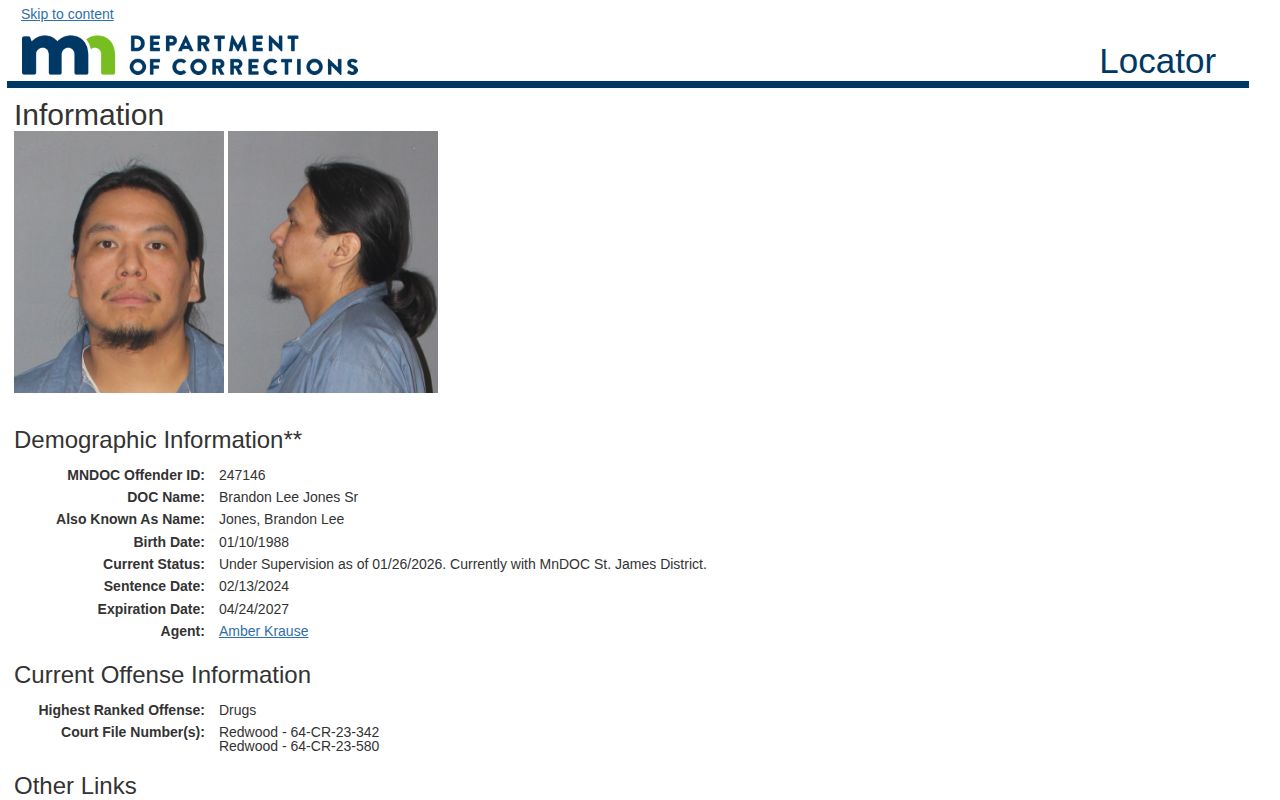
The “as of” date belongs to the displayed status. It should not be relabeled as a separately certified physical release time.
Minnesota Release and Discharge Paths
For qualifying felony crimes committed on or after August 1, 1993, Minnesota generally divides a fixed executed sentence into imprisonment and supervised release. Minnesota Statutes section 244.01 defines the term of imprisonment as two-thirds of the executed sentence. Section 244.05 provides a supervised-release term equal to one-third, subject to disciplinary confinement and other governing provisions. This is not a generic 85-percent rule.
The split is a baseline, not a safe personal calculator. Jail credit, concurrent or consecutive terms, amended sentences, disciplinary confinement, conditional-release rules, new cases, court orders, and earned incentive credit can alter the published date or the person’s legal posture. The official Anticipated Release Date is MNDOC’s current public estimate. Central Records is the source for the maintained sentence calculation.
- Supervised release
- The community portion of a qualifying fixed Minnesota sentence after imprisonment.
- Work release
- A community program or custody status that is distinct from unrestricted discharge.
- Discharge
- The end of the applicable sentence or MNDOC jurisdiction, not merely a move out of prison.
- Expiration Date
- The projected end of sentence or jurisdiction shown by MNDOC, not an actual prison-exit timestamp.
The Minnesota Supervised Release Board handles a narrower statutory caseload. It reviews life sentences with a possibility of parole or supervised release, older indeterminate sentences, and specified early-supervised-release cases under section 244.049. An ordinary determinate sentence does not become a parole case merely because “parole” is sometimes used loosely for supervision.
Minnesota Release Calendar Adjustment
Minnesota has a date rule that turns part of the release calendar on the offense date. Section 244.05, subdivision 1a addresses supervised release that would otherwise begin on a Friday, Saturday, Sunday, or legal holiday. For crimes committed before August 1, 1992, release begins on the last preceding day that qualifies under the statute. For crimes on or after that date, it begins on the first following day that is not Friday, Saturday, Sunday, or a legal holiday.
This narrow rule should not be stretched into a statewide promise about the hour or day of every custody exit. It governs the specified state-prison supervised-release calendar. It does not control a county bond release, a local transfer, federal custody, or an immigration hold. Even within MNDOC, the person’s sentence, discipline, other confinement authority, and current agency calculation still matter.
A result should therefore be checked again near the displayed Anticipated Release Date. If the date falls near a weekend or holiday, compare the offense date and current profile with the statute rather than moving the date through private arithmetic. Central Records can supply the maintained calculation when the official basis is needed.
Minnesota Gate Fee on Release
Minnesota does not promise each released state prisoner one flat cash gift. MNDOC describes Gate Fee as money allocated from a person’s prison wages. According to the agency’s financial assistance and restitution information, half of wages initially goes into Gate Fee until the balance reaches $100, followed by a 25-percent allocation. The balance can build to $500 and is not available before release. A balance “can reach” that amount; it does not mean everyone receives $500.
MNDOC Policy 203.025 addresses release transportation, and the agency’s in-facility transition services describe release preparation. Those sources should be checked for the person’s situation and holding institution. Statewide materials do not publish one universal exit hour, door, clothing package, family waiting process, or travel promise for every prison. Facility-specific facts must come from the institution, not from a broad statewide assumption.
That distinction keeps release logistics tied to official policy. Gate Fee is an accumulated wage set-aside, while transportation and transition services follow separate MNDOC procedures.
MNDOC Release Transition Trends
MNDOC’s January 1, 2026 adult prison profile reports 4,813 release-status transitions during calendar 2025. The total includes 3,723 transitions to supervised release or parole, 728 to community programs, 287 discharges, and 75 classified as other. The agency’s footnote is essential: these are transitions, not a count of unique people leaving a prison. One person can move more than once, and movement from a community program such as work release to supervision is included.
The comparable calendar-2024 total was 4,799. The later count rose by 14, about 0.3 percent. That small change does not say that 4,813 unique people walked through a prison gate in 2025. It describes the agency’s release-status categories and should be cited with its definition intact.
| Calendar year | Reported transitions | How MNDOC defines the count |
|---|---|---|
| 2024 | 4,799 | Release-status transitions, not unique prison exits. |
| 2025 | 4,813 | Includes supervision, community program, discharge, and other transitions. |
The January 1, 2026 population summary supplies the current transition breakdown, while the prior profile supports the year-to-year comparison.
MNDOC Supervision Can Mean Custody
“Under Supervision” must not be shortened to “physically free.” An MNDOC result can combine an intensive supervised-release status with the statement that the person is in custody at a non-DOC facility. In that situation, MNDOC still reports the supervision relationship while another agency holds the person. The complete status sentence and named holding agency control the interpretation.
This nuance also explains why a transfer cannot be treated as a release. A move from county jail to a state prison, federal facility, immigration detention, or another local jail ends custody at one site but continues it elsewhere. Minnesota Statutes section 13.82, subdivision 2 separately identifies the date, time, legal basis, and receiving agency for a transfer, as well as the date, time, and legal basis for release.
The official incarcerated-result example shows the future date field that must not be substituted for a current custody finding.
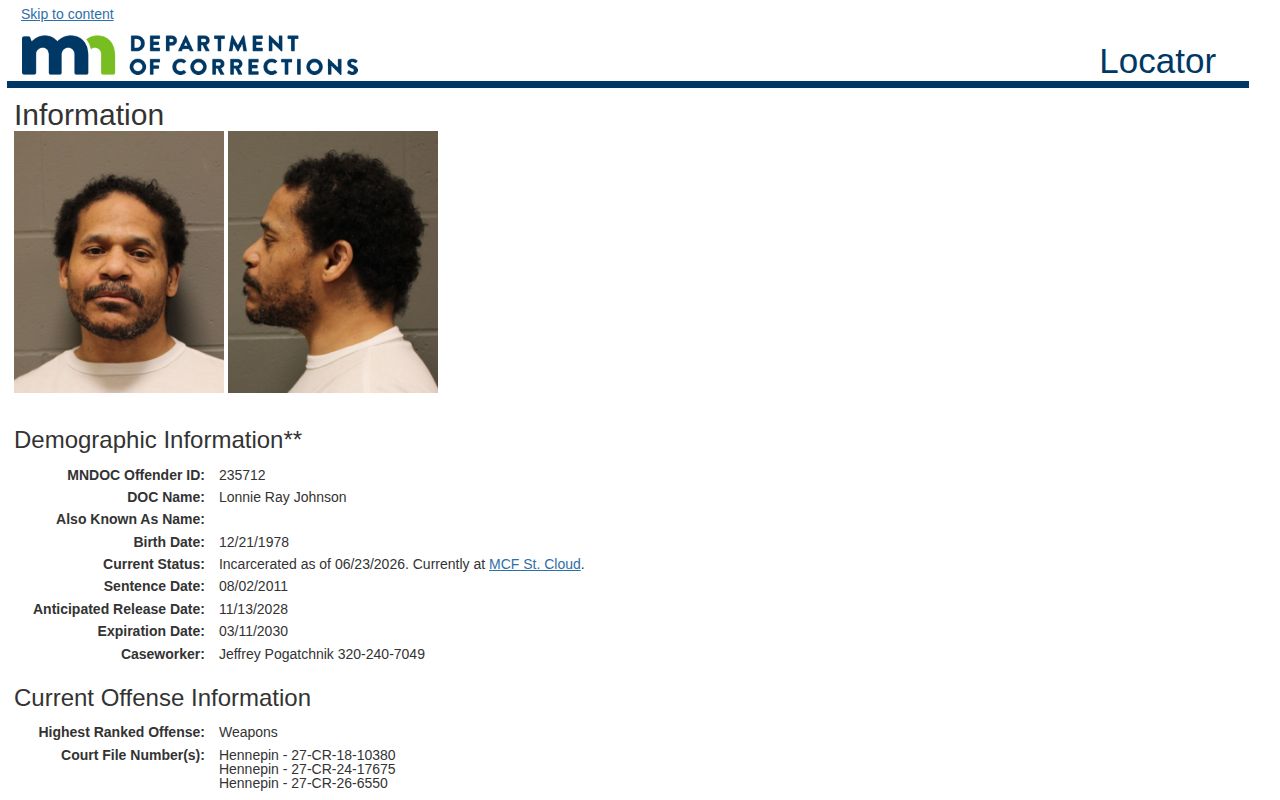
The screenshot reinforces that Anticipated Release Date is only one field; Current Status and any other-custody wording remain essential.
Note: Supervision describes a legal corrections status; a separate custody statement can show that the person is confined elsewhere.
Minnesota Release Record Layers
The MNDOC offender search covers the state-prison layer. A county sheriff maintains local arrest, transfer, and release data. The Federal Bureau of Prisons and ICE maintain separate federal systems. Choosing the correct source prevents a roster disappearance from being misread as freedom.
| Custody layer | Event to verify | Correct record source |
|---|---|---|
| MNDOC state prison | Prison status, anticipated date, supervision, or discharge | MNDOC viewer and Central Records |
| Minnesota county jail | Local release or transfer date, time, legal basis, and receiving agency | Originating sheriff under section 13.82 |
| Federal prison | Federal custody or a historical BOP release result | Federal Bureau of Prisons locator |
| Immigration detention | Current or recent ICE custody information | ICE detainee locator and the holding office |
The Minnesota County Directory routes local jail questions to the correct county. If a person left prison under supervision, the statewide Parole / Probation page explains Minnesota’s three supervision delivery systems.
Request MNDOC Release Records
The current viewer can stop showing a person after MNDOC jurisdiction fully expires. That absence is not proof that the person was never incarcerated or never released. A formal release date, release type, discharge record, unavailable historical record, or maintained sentence calculation should be requested through MNDOC Data Practices.
A focused request identifies the person by full name and MNDOC Offender ID when known. It gives an approximate custody or sentence period and states whether inspection, copies, or both are sought. The request should name existing maintained data, such as admission, facility movement, release date, release type or status, supervision start and end, expiration or final discharge, and the record showing the anticipated-date calculation. An agency need not create a new report or answer a narrative question.
Records Management lists 651-361-7330, fax 612-473-5006, and CO-Records.DOC@state.mn.us for records questions. Under Minnesota Statutes section 13.03, inspection of public government data is free, lawful copy costs may apply, and a denial must cite legal authority. Section 13.85 can protect corrections data when disclosure would endanger life, an investigation, an informant, or institutional security. Medical and other protected data may also be withheld.
A public requester generally does not need to explain a purpose, though contact or delivery details may be needed to fulfill the request. Requests from the person who is the subject of the data follow separate identity and timing rules. In either path, it helps to separate the records sought: the release event, the sentence calculation, the supervision start, and final discharge are different maintained facts. Asking for each by name reduces the chance that an Anticipated Release Date is returned when the requested fact was the actual date and status of release.
Minnesota’s Data Practices Act also distinguishes inspection from copies. A requester may ask to inspect public data at reasonable times without an inspection charge, then decide whether copies are needed. MNDOC must respond in an appropriate and prompt manner, but the statewide research does not support one guaranteed turnaround for every corrections request. When data are withheld, the response must identify the legal basis. This process preserves the difference between an accessible public field and protected corrections, medical, security, or investigative material.
The broader Minnesota data-request resource shows the statewide process captured below.
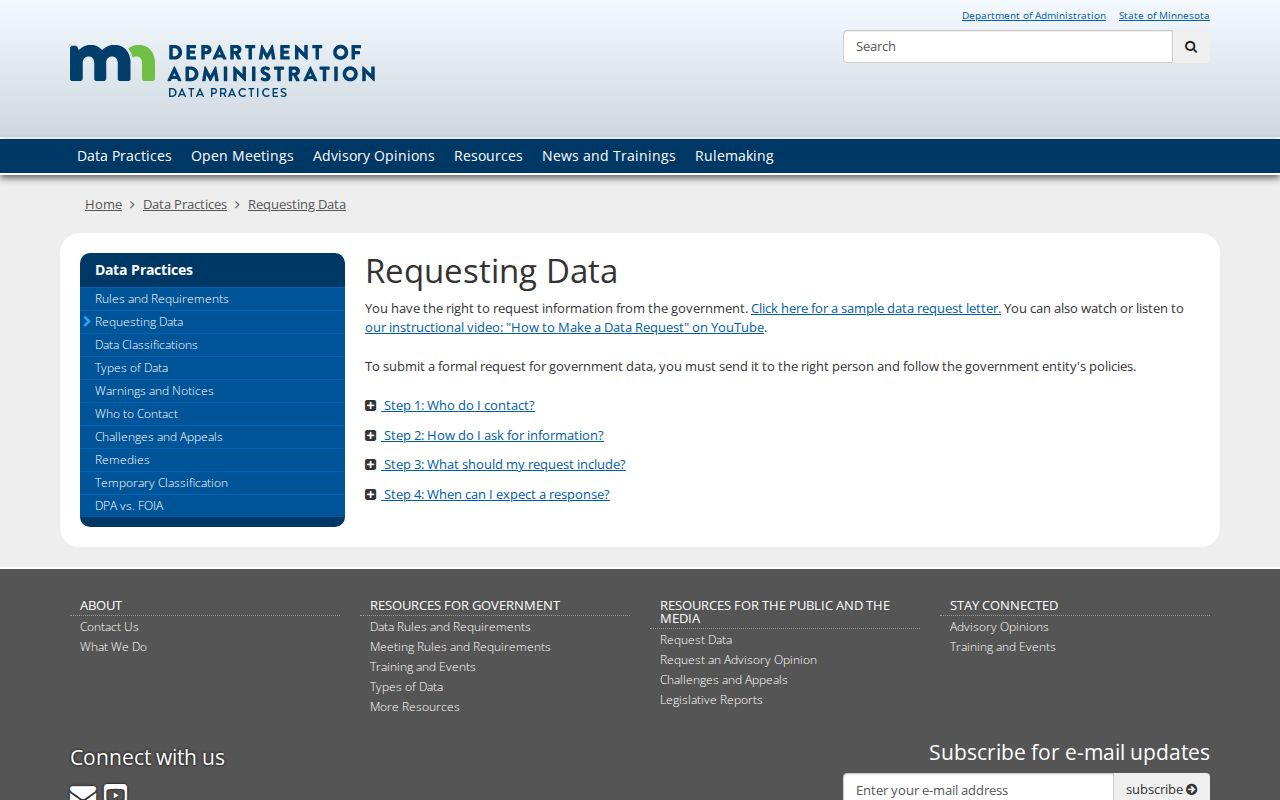
A precise request for existing fields is more useful than asking the agency to decide what happened or create a custom release narrative.